
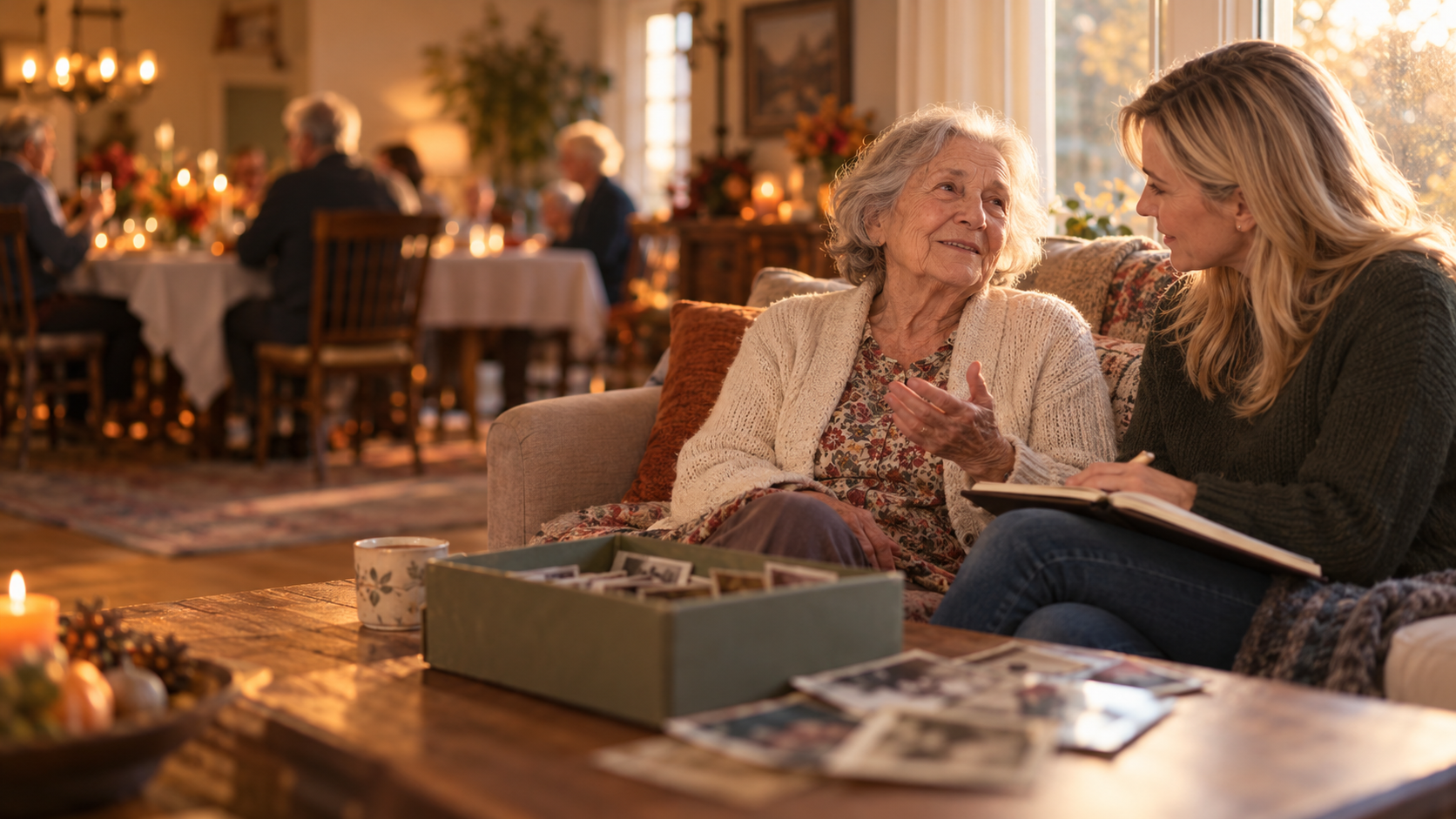
- In 2004, the U.S. Surgeon General declared Thanksgiving National Family History Day, because families are already together.
- Start with parents, siblings and children. For some diseases, having a first-degree relative with the disease doubles a person's risk, according to CDC.
- For each relative, write down their conditions, the age each was diagnosed, and the age and cause of death if they have died.
- Ask permission, keep it conversational, and write down "unknown" instead of guessing.
- Bring what you collect to your doctor, and update it when a new diagnosis happens.
Most of us carry only a rough sense of what runs in our families. We know Grandpa had a bad heart, or that an aunt had cancer, but not at what age, or whether it was the same kind. Doctors use exactly that detail.
Thanksgiving is a day when parents, siblings, cousins and grandparents are in the same room with time to talk. This guide shows you what to ask, how to bring it up without making dinner heavy, and how to write it down so your doctor can use it.
Why Thanksgiving works
In 2004, the U.S. Surgeon General declared that Thanksgiving would be National Family History Day. As CDC’s Morbidity and Mortality Weekly Report describes it, the day was designed to encourage American families to learn about and create a written record of their family health history.
The gap it was meant to close was wide. In 2004, 96% of Americans said family health history was important, but only 30% were actively collecting it. CDC’s 2017 Thanksgiving post reports that a 2014 survey of more than 5,000 respondents found collection had risen only slightly, to 37%.
These are older numbers, and we could not find a newer national figure.
It matters because family patterns can change what your doctor recommends. CDC says that having at least one first-degree relative with some diseases doubles a person’s risk for that disease. That is a reason to tell your doctor, not a diagnosis.
What to ask each relative
Start with your close relatives: your parents, your siblings and your children. If you can, add grandparents, aunts, uncles, nieces and nephews. For each person, the basics are:
CDC’s 2017 post lists conditions where family history matters, including heart disease, breast, colorectal and other cancers, diabetes, osteoporosis, glaucoma, depression and sickle cell disease. If a conversation drifts, use that list as a prompt. For mental health in particular, our article on family history of depression covers what is worth recording for each affected relative.
How to ask without making it heavy
Nobody wants a medical interview over pie. These habits keep it light.
- Ask permission and explain why.“I am writing down our family health history for my doctor. Would you be okay sharing a few things?” works better than starting with questions.
- Talk one on one. A quiet corner or a walk usually beats the dinner table. Some relatives will say things they would not say in front of everyone.
- Start with the person who knows the most. A grandparent, parent or older aunt often remembers what others have forgotten.
- Share your own first. Telling a relative what you know about your own health makes the exchange feel mutual.
- Let people skip.Some relatives find it painful or private. A “no” is an answer. Do not pass along what one relative told you to others without their agreement.
How to write it down
You do not need special software. A notes app, a spreadsheet or a sheet of paper works, as long as you capture the same four things for every person. A simple layout that is easy to read later:
| Relative | Condition | Age at diagnosis | Notes |
|---|---|---|---|
| Mother | Type 2 diabetes | About 55 | Managed with medication |
| Maternal grandfather | Heart attack | Unknown | Died at about 70 |
The rows above are synthetic examples to show the format, not real people.
In Kaizen, you can write a note that sits with your other health records, such as a summary of the family history you collected. You can edit the notes you create, and every member of the group you share it with can read it.
Get the Kaizen appWhen information is missing
Gaps are normal. Relatives may not know, may not remember, or may not want to say. You may be adopted, estranged from part of the family, or have lost touch with the people who knew.
- Write “unknown” instead of guessing. A guess can mislead a doctor. A gap tells them what to ask.
- Use what you can find. Family records and obituaries may name causes and ages that nobody remembers.
- Tell your doctor about the gaps. They can still use what you have, and they can decide how much weight to give an incomplete history.
For more on what clinicians do with this information, see our guide to documenting family health history.
After the holiday
Collecting is the start. Within a week or two, do three things.
If your history points to a specific condition, our articles on genetic risk scores and heart disease and managing diabetes as a family go deeper. For how relatives can keep one shared record, see the shared family medical record.
This is general information, not medical advice. A family history does not predict what will happen to you. Talk to your doctor about what yours means.
Frequently Asked Questions
In 2004, the U.S. Surgeon General declared that Thanksgiving would be National Family History Day. The idea was to use a day when relatives are already together to encourage families to learn about and write down their family health history.
Start with first-degree relatives: parents, siblings and children. CDC notes that having a first-degree relative with some diseases can double a person's risk for the same disease. Grandparents, aunts, uncles, nieces and nephews add useful context, especially on the side of the family where a condition appears more than once.
For each relative, write down their relationship to you, any health conditions they have or had, the age each condition was first diagnosed, and whether they have died and at what age and from what cause. Age at diagnosis matters because an earlier age is generally linked with higher risk to other family members. If nobody knows an exact age, write an approximate one.
Respect it. Health information is personal, and some relatives will not want to talk about it. Record what you do know, mark the rest as unknown, and try again another time. If family records, obituaries or older relatives can fill in a gap, use them. An incomplete history is still useful to a doctor, and "unknown" is a legitimate entry.
Bring it to your doctor, who can use it to decide whether earlier or more frequent screening makes sense for you. Keep a copy where relatives can reach it, and update it when someone in the family receives a new diagnosis. This article is general information and is not medical advice.