

A child's eyes may reveal something about depression risk years before the symptoms themselves are obvious, and new research suggests the pattern depends on family history. Most parents already track family history for heart disease or cancer. Almost nobody tracks it for depression, even though it's one of the more heritable conditions in medicine.
A 2026 study out of Binghamton University adds a new data point to that picture: children whose mothers have a history of major depressive disorder pay attention to sad faces differently than children without that history, and the pattern shifts as the child's own symptoms change.
- A 2026 Binghamton University study of 242 mother-child pairs found that children of mothers with a history of major depression showed a distinct pattern of attention to sad faces as their own depressive symptoms grew, a pattern not seen in children without that family history.
- Having a parent or sibling with major depression raises a person's own depression risk two- to threefold, from roughly a 10% baseline to 20-30%, according to Stanford Medicine.
- The risk compounds across generations: 54% of children with both a depressed parent and grandparent had an anxiety disorder, compared with 11% of children with no family history, per Columbia University's Mailman School of Public Health.
- Family history changes risk, not destiny. Most children with a depressed parent do not go on to develop depression themselves.
- Recording mental-health family history with the same structure used for physical conditions (relation, age of onset, recurrence) gives a pediatrician something they can actually act on.
What the new study found
Researchers at Binghamton University's Mood Disorders Institute followed 242 children and their mothers for two years, assessing them every six months. Children watched pairs of faces on a screen, one neutral and one showing happiness, sadness, or anger, while eye-tracking technology recorded which face they looked at more.
Among children whose mothers had a history of major depressive disorder, growing depressive symptoms were associated with increased attention to sad faces. Children of mothers without that history showed a different pattern: as their symptoms increased, they tended to look less at happy faces, rather than more at sad ones. The study was led by PhD student Kelly Gair and senior author Brandon Gibb, a SUNY Distinguished Professor of Psychology and director of Binghamton's Mood Disorders Institute, and was published in the Journal of Psychopathology and Clinical Science (Binghamton University, June 2026).
Why this matters, even though it's not a test
The Binghamton researchers were careful about what the finding does and doesn't show. The attention-to-sad-faces pattern tracked alongside a child's existing depressive symptoms. It followed the symptoms rather than predicting them ahead of time. That means it isn't a screening tool a pediatrician can use today to flag which kids will become depressed.
What it does add is more evidence that family history shapes how a child's brain processes emotional information right now, not only a child's odds of a diagnosis later.
How much does family history actually raise the risk?
Parental depression raises a child's risk of depression, anxiety, disruptive disorders, and substance use by two- to fivefold, according to Columbia University's Mailman School of Public Health. The most-cited version of that range is specific: if a parent or sibling has major depression, a person's own lifetime risk is roughly two to three times the average person's, or about 20-30% instead of a 10% baseline (Stanford Medicine). For early-onset, recurrent depression specifically, siblings and children of an affected person develop it at four to five times the average rate.
The risk compounds across generations. Children with both a depressed parent and a depressed grandparent had an anxiety disorder 54% of the time, compared with 11% of children with no family history of depression at all, according to Columbia's Mailman School of Public Health. That gap comes from cumulative risk across generations, not a single gene.
What counts as “family history” for mental health
Family mental-health history means more than a vague sense that “my mom struggled with depression.” The details that actually change the risk calculus are the same ones clinicians ask about for physical conditions: how closely related the affected person is, how early their depression started, and whether it recurred.
Early signs worth watching for
Genetics explains a meaningful but partial share of depression risk. Twin and adoption studies put the heritability of depressive symptoms at roughly 30-40%, meaning environment, parenting, and life events still account for most of the variation (Stanford Medicine). That makes watching for early signs worthwhile precisely because family history isn't destiny.
In children, depression often looks less like sadness and more like irritability, withdrawal from activities they used to enjoy, changes in sleep or appetite, or a drop in school performance. None of those signs are diagnostic on their own. What changes with a known family history is the threshold for taking them seriously and bringing them to a pediatrician rather than waiting to see if they pass.
“Family history changes the threshold for paying attention, not the certainty of an outcome.”
How to actually track family mental-health history
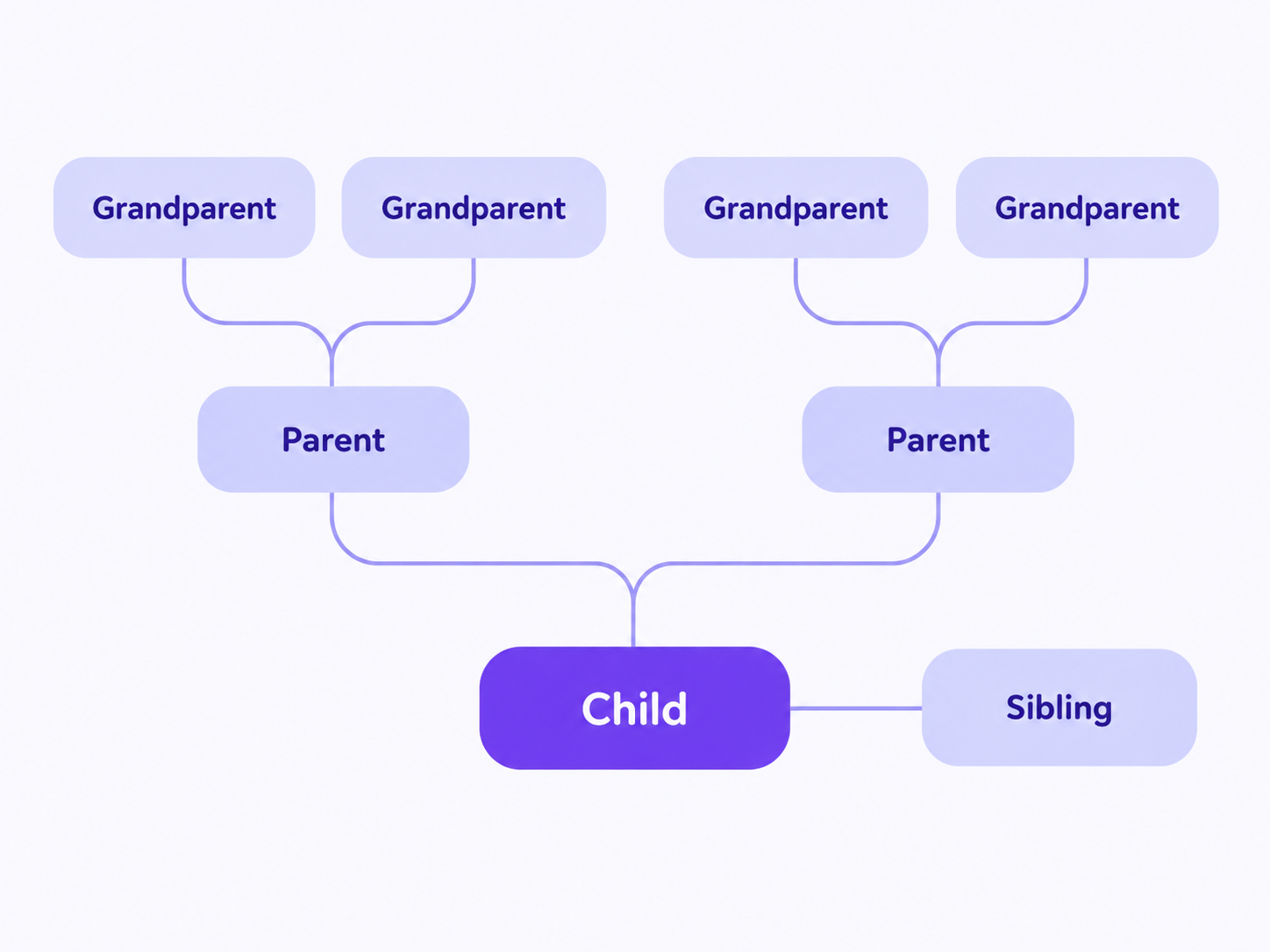
Most families already keep some version of a health history for cardiac disease, cancer, or diabetes: relation, condition, age of onset, whether it recurred. Mental health rarely gets the same structured treatment, even though the same fields apply directly. Recording it that way turns a vague sense that “it runs in the family” into something a pediatrician or therapist can actually use at an intake appointment.
For each affected relative, the useful fields are the same ones covered above: relation to the child, the condition, age at onset, whether it was treated, and whether it recurred. Keeping that record somewhere both parents (and eventually the child's other caregivers) can update and share matters as much as collecting it in the first place. See our guide to organizing medical records for family members and, for households juggling several caregivers, keeping a shared family medical record everyone with a legitimate need can actually reach.
Kaizen keeps family health history, physical and mental, in one shared record, so a relative's age of onset or recurrence isn't something you're trying to recall correctly in a pediatrician's waiting room.
Try it with a documentWhat this doesn't mean
Family history changes risk, not destiny. A parent or sibling with major depression roughly doubles or triples a person's own chances, but that still means most people with that family history never develop the condition themselves. Protective factors measurably change outcomes for kids with an elevated family-history risk: secure attachment, access to treatment, and a parent's own recovery and ongoing treatment. The point of tracking this information isn't to predict an outcome. It's to make sure the people caring for a child, at home and in the exam room, aren't working from a blank slate.
A parent or sibling's depression history is one of the more useful things a pediatrician can know about a child that a standard checkup won't surface on its own. That's the same logic behind using family health history to guide screening and prevention more broadly. Start with what you already know, record it the same structured way you would a cardiac or cancer history, and bring it to the next appointment.
Frequently Asked Questions
Yes. Twin and adoption studies put the heritability of depressive symptoms at roughly 30 to 40 percent, and having a parent or sibling with major depression is linked to a two- to threefold increase in a person's own lifetime risk, according to Stanford Medicine's genetics of depression overview.