
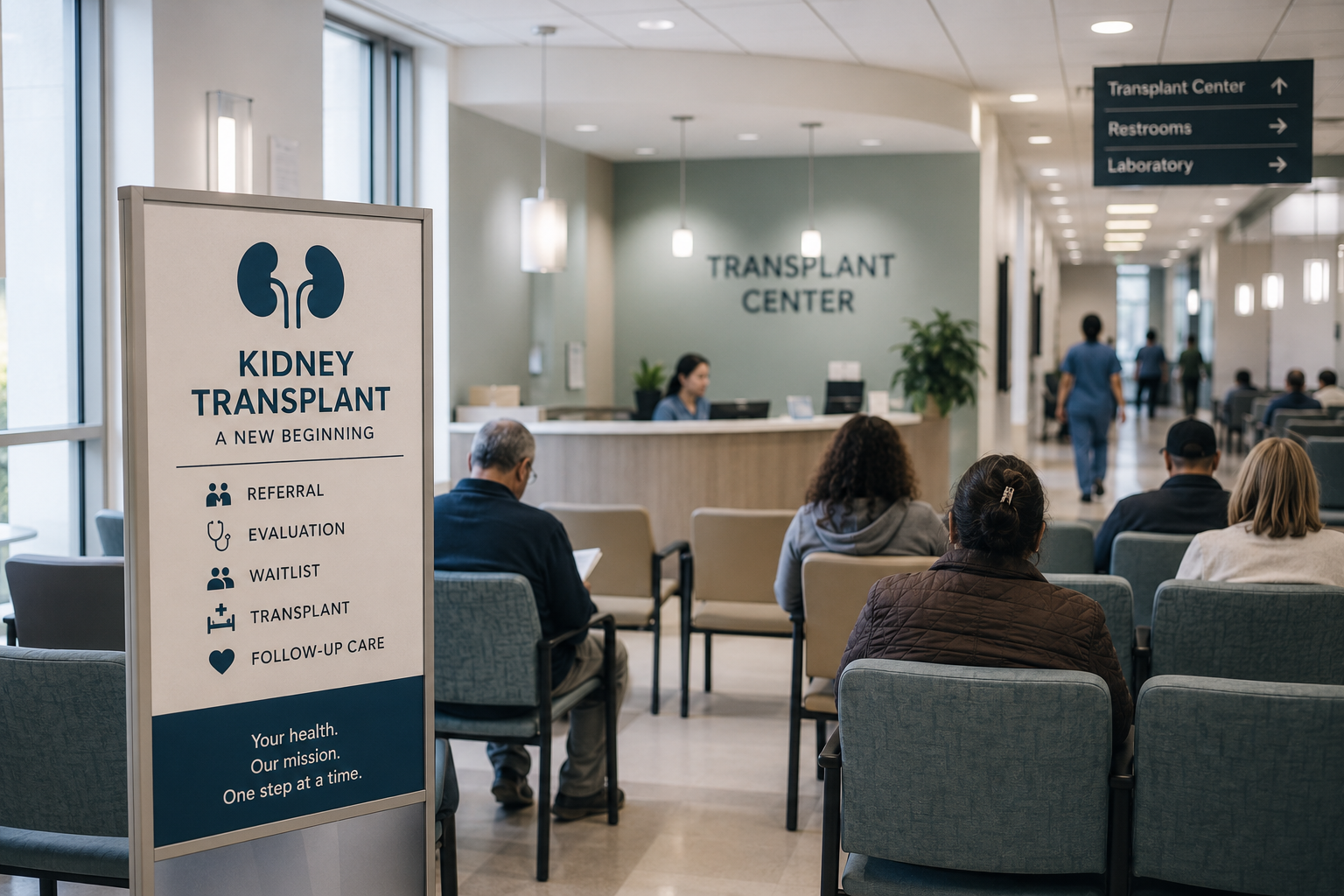
- A 2026 study of 720,348 referred patients found 48% never began a kidney transplant evaluation, and only 19% reached the waitlist.
- Being unmarried, living rurally, having severe obesity, speaking Spanish, having a lower income, or being treated at a smaller center were all linked to lower odds of completing the process.
- The evaluation itself is an obstacle course: blood work, imaging, cancer screening, a cardiac workup, and appointments with multiple specialists, spread over months, on top of ongoing dialysis.
- Evaluations often stall on one missing test or piece of paperwork rather than a medical disqualification, which is where an organized advocate can make the most difference.
Roughly 90,000 people in the United States are on the national kidney transplant waiting list right now, and most of them will wait three to five years for an offer. That number, grim as it is, describes only the people who made it onto the list. A study published in June 2026 looked at everyone who did not, and found that the biggest drop-off happens long before anyone gets near a waiting list at all.
Researchers at NYU Langone Health tracked 720,348 patients referred for a kidney transplant between 2014 and 2025. Nearly half of them, 48%, never even began the evaluation process their transplant center required. Only 19% completed it and reached the waitlist.
The number behind the number
Transplant research and transplant advocacy have both spent years focused on what happens after someone reaches the waiting list: how long they wait, who gets an organ first, how to grow the donor pool. The study, published in the Journal of the American Society of Nephrology and simultaneously presented at the American Transplant Congress, points at the much larger and less examined stage before that: the months between a referral and a completed evaluation, where most candidates are lost.
Lead author Conor Donnelly, MD, and co-senior authors Allan B. Massie, PhD, and Michal A. Mankowski, PhD, pulled their data from Epic Cosmos, a research database drawing on more than 300 million patient records across over 1,850 hospitals, including roughly a third of US transplant centers. That scale is what makes the finding hard to write off as one region's problem or one hospital's paperwork backlog.
What the study found
Framed as a funnel, the numbers are stark. Of every 100 people referred for a kidney transplant:
That leaves roughly a third of referred patients somewhere in between: they started the evaluation but did not finish it, or finished it but were not listed for other medical or administrative reasons. Being referred by a nephrologist, in other words, is closer to the starting gun than the halfway point.
Four places to fall through the cracks
A kidney transplant referral is not a single event; it is a sequence, and the study's design tracked each step separately:
Each step is a place where a missed appointment, an unreachable phone number, an unpaid bill, or a form that never got returned can quietly end the process, without anyone officially deciding the patient is ineligible.
Who is least likely to make it through
The study did not find a uniform drop-off. Specific groups were significantly less likely to progress from referral to the waitlist:
- Unmarried patients
- Patients with severe obesity
- Patients living in rural areas
- Older patients
- Spanish-speaking patients
- Patients with lower household income
- Patients treated at smaller transplant centers
- Patients in transplant programs in the South
Urban patients, by contrast, were generally more likely to advance. None of these are medical exclusion criteria on their own. A person is not too unmarried or too rural to receive a kidney. What they describe instead is how much unpaid logistical and social support the process quietly assumes a patient already has: a spouse to help track appointments and drive to them, proximity to a well-resourced center, fluency in the language the paperwork is written in, and the income to absorb the cost of repeated travel and time off work.
“Which transplant center you go to, where you live, and even whether you are married all appear to influence your chances of moving forward to the waitlist for a new kidney.”
Why the evaluation itself is the bottleneck
A kidney transplant evaluation is not one visit. It typically includes extensive blood work, chest imaging, age-appropriate cancer screening, a cardiac workup, and separate appointments with a transplant surgeon, a nephrologist, a social worker, and a dietitian. Depending on a patient's other conditions, it can also mean a psychological evaluation and a review of financial and insurance coverage for both the surgery and the anti-rejection medications that follow it for life.
All of that has to happen on top of an existing dialysis schedule, which for most patients already means three sessions a week, four hours at a time. A patient managing that schedule, plus a job, plus other health conditions, has to coordinate several more appointments with several more providers, often at a center that is not the one where they get their regular dialysis care, over a period that can run several months. Every one of those appointments is a point where transportation, cost, or a scheduling conflict can cause a delay that compounds into the patient falling out of the process entirely.
The scale of kidney failure in the US
The evaluation gap matters because of how many people it touches. More than 808,000 Americans are living with kidney failure. As of USRDS 2025 data, about 517,000 of them are on dialysis and roughly 317,000 are living with a functioning transplant. A transplant generally offers a longer life expectancy and a far better quality of life than years on dialysis, which is part of why the size of the group stalled somewhere between referral and the waiting list is so consequential.
For the people who do reach the waitlist, the wait is not short. Roughly 90,000 people are listed at any given time, and most wait three to five years or longer. On average, 13 people die every day waiting for a kidney. None of that changes for the better if half of referred patients never reach the starting line.
If you're navigating this for yourself or someone else
The study's authors were careful to note what their data cannot show: it cannot tell you, for any single patient, whether a stalled evaluation reflects a real medical barrier or a logistical one that better support could fix. What it does make clear is that the odds are not even, and that the difference often comes down to who has help managing the paperwork and the schedule.

Kaizen keeps every test result, referral, and appointment note from a transplant evaluation in one shared record, so nothing gets lost between the nephrologist, the transplant center, and the specialists in between, and everyone helping with care can see what's still outstanding.
Try it with a documentQuestions worth asking the transplant center
A few direct questions can surface where a case actually stands, rather than waiting for a call that may not come:
- What specific tests or appointments are still outstanding?
- Is there a target date for when the transplant committee will review the file?
- Does this center have data on its own evaluation completion rate, and how does it compare to other centers nearby?
- Is a second opinion at another transplant center worth pursuing, given that completion rates vary significantly by center and region?
- Is there a social worker or financial counselor who can help with transportation, lodging, or insurance issues?
The researchers behind this study argue that transplant centers and policymakers need to look upstream of the waiting list, not just at it. Until that shifts, the most reliable lever most families have is the one inside the process already: staying organized enough that a stalled file gets caught before it quietly becomes a closed one.
Frequently Asked Questions
Roughly 90,000 people are on the national kidney transplant waiting list at any given time, and most face a wait of three to five years or longer before an offer, according to the National Kidney Foundation. That number only counts people who made it onto the list. It does not count the larger group referred for a transplant who never got that far.