
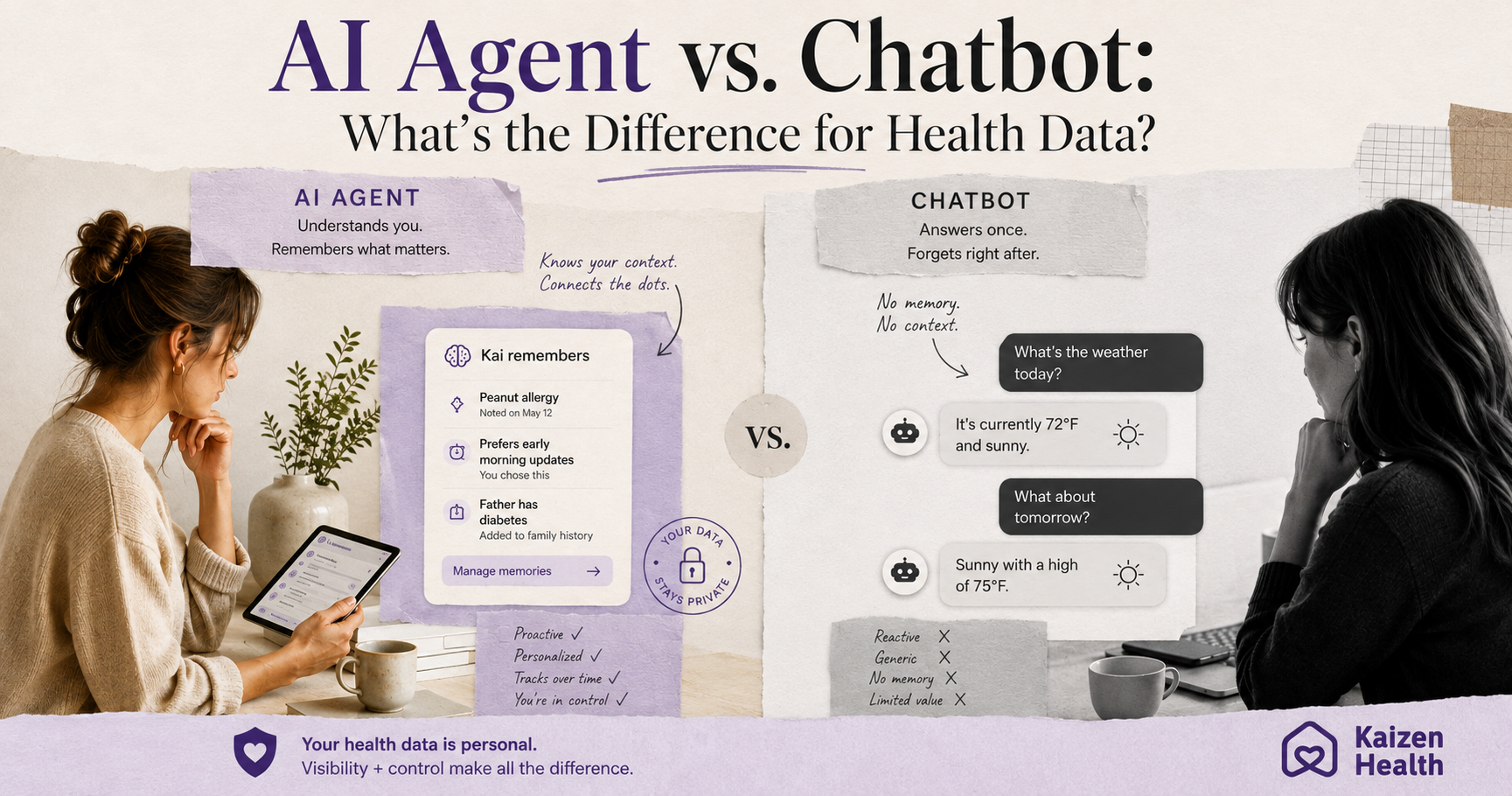
- A chatbot answers one message at a time. An AI agent can be given standing access to a set of records and act on them across multiple steps without a fresh prompt each time — that access difference is what actually matters once health data is involved.
- Patients are three times more likely to trust an AI agent embedded in a clinical, purpose-built system than a public general-purpose chatbot (Fierce Healthcare, 2026).
- Most consumer AI products, chatbot or agent, are not covered by HIPAA the way a doctor's office is, and whether your data trains the model or how long it's kept depends on the specific product's policy, not an industry standard.
- Older health chatbots, like symptom checkers, only ever answered what you typed in that session. Today's agents can be granted an ongoing line of sight into a family's full record, which is a bigger decision than picking a smarter search box.
- Before connecting any AI tool to family health records, check the same three things regardless of what the product calls itself: HIPAA coverage, training policy, and how long your data is retained.
“AI agent” and “AI chatbot” get used almost interchangeably in marketing copy, and for a lot of everyday questions the distinction genuinely doesn’t matter. It matters the moment a parent’s lab results, a child’s medication list, or a family’s medical history is what you’re handing over. This isn’t new behavior that appeared with the 2026 product wave, either. A 2024 KFF tracking poll found 17% of adults already used AI chatbots at least monthly for health information (25% among adults under 30), and 56% of them weren’t confident they could tell an accurate answer from an inaccurate one. By March 2026, a separate KFF poll found 32% had turned to AI chatbots for health information in the past year. The behavior predates the branding. What’s changed is how much access these tools can now be given. Our guide to AI agents in family health covers the category at a high level; this piece goes deeper on the one question that actually changes what you should do before you use one: what does “agent” versus “chatbot” mean for the data itself, not just for how the conversation feels?
The real difference between an agent and a chatbot
A chatbot answers one message at a time, inside a single conversation, and generally knows only what you typed into that conversation. An AI agent can be given standing permission to access a set of information, such as uploaded records or a connected account, and act on it across multiple steps without you re-prompting for each one. The word “agent” describes a capability, not a personality: it can look things up, use connected tools, and carry context forward on its own.
A real technical mechanism sits behind that capability. Anthropic’s Model Context Protocol (MCP) is an open standard for this. It lets an AI agent form a persistent, two-way connection to outside data sources and tools, instead of operating inside an isolated chat window. It’s since been adopted across ChatGPT, Claude, Gemini, and Copilot, and in December 2025 it was placed under a vendor-neutral Linux Foundation project, the Agentic AI Foundation, backed by Anthropic, OpenAI, Google, Microsoft, and Amazon. That’s the plumbing that makes “standing access to a records system” possible. It’s becoming a shared, industry-wide default rather than one company’s feature.
| Chatbot | AI agent | |
|---|---|---|
| How it responds | One message at a time, inside a single conversation | Can take multiple steps toward a goal without a fresh prompt for each one |
| Access to your data | Generally limited to what you typed in that session | Can be granted standing access to uploaded records or connected accounts |
| Memory | Typically forgets once the conversation ends, unless memory is added as a separate feature | Often designed to retain context and use it in later sessions |
| Typical health example | A symptom-checker exchange: you describe symptoms, it suggests possible causes | A tool that reads a parent’s uploaded lab results and flags a pattern across visits without being asked each time |
| What you need to check | What happens to what you typed today | Everything it has standing permission to see, not just today’s message |
Why this matters specifically for health data
Health data is unusually sensitive, and agent-style tools are exactly the ones being asked to hold the deepest access to it. A single symptom question typed into a chatbot exposes one message. An agent with standing access to a family’s uploaded records, or to a connected patient portal, can see everything in that record every time it’s used, whether or not you’re actively thinking about privacy in that moment. The access decision gets made once, in a settings screen, rather than re-confirmed with every question you ask.
Trust research suggests people already sense this difference, even without being able to name it in technical terms. According to survey findings reported by Fierce Healthcare, patients are three times more likely to trust an AI agent when it’s embedded in a clinical, purpose-built system than a public, general-purpose chatbot, even when the underlying technology is the same. People are responding to institutional accountability, not the interface.
Agents aren’t worse than chatbots, or the reverse. The stakes of the access decision scale with what the tool is allowed to see, and an agent is, by design, allowed to see more for longer.
Does an AI agent remember your family between conversations?
Some do, and some don’t, and it’s a setting to check rather than an assumption to make. By 2026, persistent memory across sessions had become a common feature among general-purpose AI assistants generally, not just health-specific ones: the product remembers details from earlier conversations and brings them back later without you repeating yourself. That’s convenient for a family tracking an ongoing situation, and it’s exactly the feature that turns a one-time disclosure into a standing one.
The practical wrinkle is that deleting a single conversation does not necessarily delete what the system separately retained from it. A “clear chat” button and a memory-reset control are not always the same button. Before treating an AI tool as private, confirm there’s a specific setting for viewing and deleting what it remembers about your family, not just the visible transcript.
Does it train on your family’s data?
It depends entirely on the product’s specific policy, and the default is usually opt-out, not opt-in. When Anthropic changed its consumer Claude policy in August 2025, it began training on user conversations by default unless someone actively opted out by a set deadline; opted-in data could be retained for up to five years, versus a 30-day, no-training window for anyone who opted out in time. Enterprise, API, government, and education accounts were unaffected. Similar default-in mechanics are common across general-purpose consumer AI products. This isn’t about any one company doing something wrong. The default almost never protects you automatically, and “we may use data to improve our services” is not the same commitment as an explicit no-training statement.
Two things are worth checking separately in the settings menu, because products sometimes treat them differently: whether typed messages train the model, and whether uploaded documents (a lab PDF, a discharge summary) do too. A policy that’s clear about one and silent about the other is not a complete answer.
Is it covered by HIPAA?
Usually not, regardless of whether the product is called a chatbot or an agent. HIPAA covers healthcare providers, health plans, and clearinghouses, along with vendors that have signed a business associate agreement with one of them. A general-purpose assistant that added a health feature isn’t automatically a HIPAA covered entity just because people use it to discuss health topics, and the “agent” label doesn’t change that analysis.
The same IAPP reporting on the 2026 health AI launches found that data retention periods were largely undisclosed across the group, and that consumer AI products generally are not bound by HIPAA the way a hospital system or a doctor’s office is. That gap applies equally whether the specific feature you’re using is framed as a chatbot or an agent; the HIPAA question is about the company and the contract, not the interface. HIPAA Journal’s analysis of ChatGPT makes the same point concretely. Consumer-tier general chat products typically don’t sign business associate agreements. Paste protected health information into a free or standard consumer tier, and it sits outside HIPAA’s jurisdiction, governed instead by the vendor’s ordinary terms of service.
Regulation is starting to catch up, but it hasn’t arrived yet. In January 2025, HHS’s Office for Civil Rights proposed the first major update to the HIPAA Security Rule in 20 years, which would require covered entities to include any AI tool that creates, receives, maintains, or transmits health data in their formal technology inventory and risk analysis. As of this writing, that rule remains a proposal, not a requirement, and it would still only apply to entities already covered by HIPAA in the first place, not to a general consumer AI product on its own.
How long is your data kept?
Often for longer than a user would assume, and often without a clearly stated number. The same IAPP analysis of the 2026 launches found retention periods were largely undisclosed across the five products it reviewed, which means “how long is this kept” isn’t a question most consumer AI products answer up front. The safer approach is to look for an explicit stated retention window and a direct way to request deletion, rather than assuming a short, session-only lifespan just because the interaction felt temporary.
Kaizen Health is a specific, checkable example of what the alternative looks like: Kai doesn’t train on your family’s health data, and Kaizen has signed business associate agreements with OpenAI and Anthropic, the AI providers used in specific app features, so that data is contractually covered under HIPAA rather than protected only by policy language. That’s the kind of detail this section has been arguing you should look for in any tool, including this one, rather than take on faith.
Are older health chatbots the same risk as new AI agents?
No, but not because older tools were inherently safer. They were architecturally limited to a smaller kind of access. Tools like the WebMD Symptom Checker and Ada Health’s symptom-checking assistant, both long-standing products that predate the 2026 “agent” wave, work the same way a chatbot does: you describe what’s going on, they respond to that specific input, and the interaction generally ends there. They were never designed to be handed standing access to a parent’s full chart or a connected patient portal.
The 2026 wave of health AI products changes that shape. When a product can be connected to uploaded records, a patient portal, or another app and asked to act on that connection over time, the relevant question stops being “what did I just type” and becomes “what can this thing see whenever it wants to.” That doesn’t argue against using newer tools. It’s a reason to read the access screen the way you’d read a permissions request on a new app, instead of skimming past it the way you might with a search box.
This is separate from the access question, but even the older generation of chatbots wasn’t automatically safer on the advice side. A 2023 study in JMIR mHealth and uHealth tested Ada Health, WebMD, and ChatGPT-3.5 against 40 real emergency department cases. Physicians matched the correct top diagnosis 47% of the time. Ada and WebMD matched 30% and 40%, with unsafe-triage rates of 14% and 19%. ChatGPT-3.5 also matched 40%, but its unsafe- triage rate was 41%, high enough that the study authors concluded unsupervised use of general-purpose AI for diagnosis and triage wasn’t advisable. That result is specific to a 2023-era model and doesn’t describe today’s agent products. But it confirms that access scope and answer accuracy are separate risks. A tool can fail on either one independently of the other.
What to check before you connect one to family health data
The same short list applies whether the product in front of you calls itself a chatbot, an assistant, or an agent.
Where Kaizen Health fits
Kai, Kaizen Health’s AI assistant, is built specifically to summarize the records a family chooses to upload and answer questions about them, on a HIPAA-compliant platform where personal health data is never used to train the underlying model. Kai answers the access question this article walks through directly, in writing, instead of leaving a family to infer it from a general privacy policy written for a much broader product.
Upload a lab result, a discharge summary, or a medication list, and ask Kai what changed. Sharing controls are set by your family and can be changed at any time — nothing is granted by default that you didn't choose to share.
Try it with a documentThe comparison of exactly which 2026 products handle these questions differently is its own piece: Copilot Health, ChatGPT Health & Amazon Health AI, Compared. (Claude for Healthcare and Perplexity Health, the other two products from the same early-2026 wave, aren’t covered there.) And for what the data itself actually shows, incidents, regulatory activity, and the family-specific questions still unanswered, see is it safe to share family medical records with AI. For now, one takeaway holds regardless of which product you’re looking at. “Agent” describes what a tool is allowed to do, not how trustworthy it is. You answer the trustworthiness question yourself, by checking access, memory, training, HIPAA status, and retention, not by reading the marketing.
Whoever ends up doing that checking is usually the same person already coordinating everything else about a parent’s care: appointments, medications, insurance calls, and now, a privacy settings menu. That role carries its own well-documented cost, and it’s worth naming even when the topic at hand is software. Our guide to the hidden retirement cost of family caregiving covers the part of that cost that rarely makes it into a settings screen.
If you haven’t organized what records exist yet, that’s worth doing before any AI tool enters the picture. Our guide to organizing medical records for aging parents is a reasonable place to start, and it makes the access question in this article easier to answer, because you’ll actually know what you’re deciding to share.
Frequently Asked Questions
A chatbot answers one message at a time, inside a single conversation, and generally has no access beyond what you typed. An AI agent can be given standing permission to access a set of information, such as uploaded medical records or a connected account, and act on it across multiple steps without being re-prompted each time. For health data specifically, that access difference is what matters: a chatbot only ever knows what you told it today, while an agent can be granted an ongoing line of sight into a family's full record.
It depends on the product, not on whether it's labeled a chatbot or an agent. Check three things first: whether it's actually covered by HIPAA, whether your input is used to train the underlying model, and how long the company keeps it. Most general-purpose consumer AI products fall short on at least one of those, according to reporting from the International Association of Privacy Professionals on the 2026 wave of health AI launches.
Not necessarily, but you have to check rather than assume. Some products explicitly exclude health data or documents you upload from training; others use vaguer language like "we may use data to improve our services," which is not the same commitment. Look for a specific, unambiguous no-training statement in the product's own privacy documentation, and check whether it applies to everything you share or only to certain kinds of input.
Look for a memory or data-management setting that is separate from simply deleting a chat thread. Many AI products now carry information forward across sessions as a persistent memory feature, which means clearing a conversation window does not necessarily clear what the underlying system has retained about you. A tool built specifically for health records should make it clear what it remembers and give you a direct way to remove it.
Coverage depends on whether the company is a HIPAA covered entity (a healthcare provider, health plan, or clearinghouse) or has signed a business associate agreement with one, not on whether the product uses the word "agent." A general-purpose assistant that added a health feature is not automatically covered just because people use it to ask health questions. If a product doesn't clearly state its HIPAA status, treat that silence as the answer.