
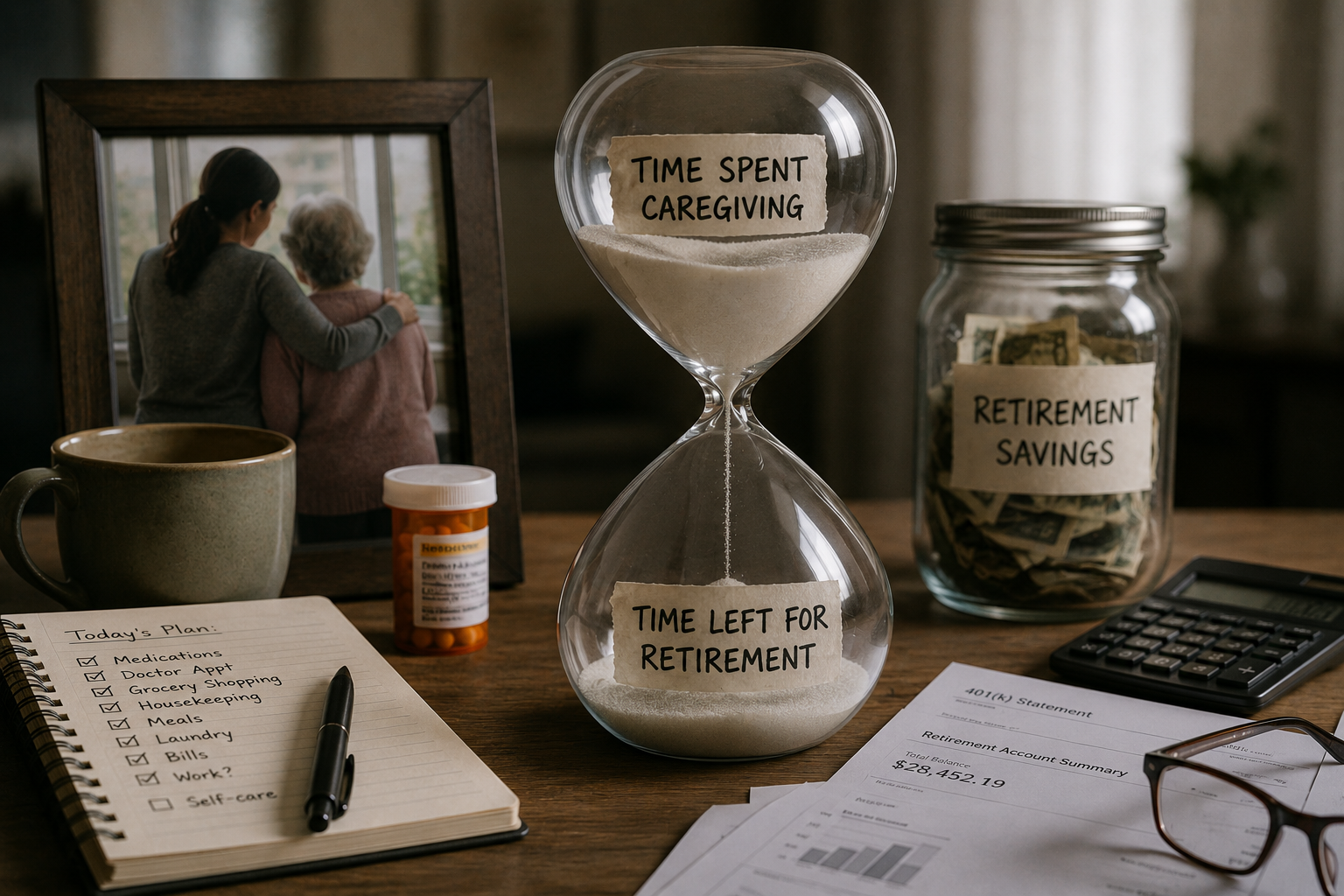
- AARP found family caregivers spend about $7,242 a year out of pocket, roughly 26% of their income — and about half of that spending is household costs, not medical bills.
- The larger cost is usually invisible: reduced hours, unpaid leave, and paused retirement contributions during peak earning years.
- Three years of skipped $500-a-month contributions is $18,000 not saved, but closer to $77,000 not held in retirement 20 years later at a 7% return.
- Social Security averages your 35 highest-earning years, so caregiving gaps can lower the benefit itself if you have fewer than 35 strong years on record.
- The most useful family conversation happens before a crisis: who provides care, who pays, and how the primary caregiver keeps earning and saving.
Caring for an aging parent is usually described as a labor of love, and it is. It is also a financial event, and one that gets measured badly. Families tend to count what caregiving costs the way they count a vacation: by adding up receipts. Prescriptions, gas, a grab bar in the shower, a few days of unpaid leave.
The receipts are the smaller number. The larger one is the income a caregiver never earns and the retirement contributions they never make during what are often their highest-earning years. That cost does not stop when the caregiving stops. It compounds — or rather, it fails to.
What caregiving actually costs
The scale of unpaid family caregiving in the United States is easy to underestimate. A 2025 report from AARP and the National Alliance for Caregiving found that 63 million Americans — nearly one in four adults — provided ongoing care to an adult or a child with a complex condition in the past year, up about 20 million from a decade earlier. Six in ten of those caregivers were also employed. AARP’s companion Valuing the Invaluable analysis put the market value of that unpaid work at roughly $1.01 trillion a year across 49.5 billion hours.
For an individual family, the out-of-pocket piece is more concrete. AARP’s out-of-pocket costs study put average annual caregiving spending at $7,242, or about 26% of a caregiver’s income. The composition is the surprising part. Only about 17% of caregivers reported medical costs as a spending category. Half reported general household expenses, 30% helped with rent or mortgage payments, and 21% paid for home modifications. Only 5% reported no caregiving expenses at all.
That last figure comes from a different kind of accounting, and it is the one this article is about.
The paycheck you never receive
The most-cited estimate of caregiving’s long-run financial cost comes from the MetLife Study of Caregiving Costs to Working Caregivers, produced with the National Alliance for Caregiving and the Center for Long Term Care Research and Policy. It estimated that a caregiver aged 50 or older who leaves the workforce to care for a parent loses an average of $303,880 over a lifetime: about $115,900 in wages, $137,980 in Social Security benefits, and conservatively $50,000 in pension value. Women averaged $324,044; men, $283,716.
Two caveats matter. That study is from 2011, and it models people who leave work entirely, not everyone who cuts back. Treat it as an order of magnitude rather than a quote. What it establishes is the shape of the problem: in that estimate, lost wages are the smallest of the three components. Social Security and pension effects — the parts nobody sees until decades later — were more than half the total.
Consider someone earning $75,000 who drops to $60,000 for three years to manage a parent’s care. The obvious cost is $45,000 in forgone wages. The less obvious costs stack on top of it: a smaller 401(k) contribution base, a smaller employer match, three years of missed raise compounding, and three weaker years in the earnings record Social Security will eventually average.
“This research makes painfully clear that family caregiving is no longer a looming crisis — it's a daily reality.”
That is Jason Resendez, president of the National Alliance for Caregiving, on the 2025 findings. The everyday-ness is the point: the financial damage rarely arrives as one catastrophic bill. It arrives as a series of individually reasonable decisions to work a little less.
The math on three skipped years
Take the single most common adjustment: pausing retirement contributions. Suppose a caregiver normally puts $500 a month into a 401(k) and stops for three years.
The contributions not made total $18,000. That is the number most people have in mind, and it is the wrong one. Assuming a 7% average annual return, those contributions would have been worth roughly $20,000 by the end of the three-year pause. Left alone after that, they would have grown to about:
- $39,000 if retirement is 10 years away
- $55,000 if retirement is 15 years away
- $77,000 if retirement is 20 years away
- $108,000 if retirement is 25 years away
So an $18,000 decision made at 45 is closer to a $77,000 decision by 65. And that is before the employer match. If the employer matched 3% of a $75,000 salary, the forgone match over three years is $6,750 in free money — which itself would have been worth roughly $29,000 after 20 more years of growth.
You can run the same math with your own salary, reduced hours, timeline, contribution rate, and employer match in our free caregiver cost calculator. It also shows what keeping five paid work hours a week could protect over time.
Returns are not guaranteed and 7% is an assumption, not a promise. But the direction is not in question: the cost of a contribution gap is set by how much time the money had left to grow, which is exactly why gaps in your 40s and 50s hurt more than the raw dollar amount suggests.

Why a career break keeps costing
Leaving a job to provide full-time care often feels temporary. Returning is rarely as simple as picking back up. In the 2025 AARP and NAC survey, half of employed caregivers reported work disruptions — arriving late, leaving early, cutting hours — and nearly half reported a major financial impact such as taking on debt, stopping savings, or experiencing food insecurity.
A break tends to cost in several directions at once:
- Missed promotions and the raises that would have followed them
- Salary growth that restarts from the old number, not the projected one
- Lost employer retirement match, which is not recoverable later
- Loss of employer health coverage, sometimes at an age when replacing it is expensive
- Professional networks that thin out while you are away
- Re-entry at a lower level or in a lower-paying role
Because retirement saving is usually a percentage of income, a permanent step down in salary quietly becomes a permanent step down in saving rate, long after the caregiving has ended.
It is worth weighing all of that against what the alternative actually costs. According to the 2025 CareScout Cost of Care Survey, the national median for a non-medical in-home caregiver is $35 an hour, or about $80,080 a year at 44 hours a week, and a semi-private nursing home room runs a median $114,975 a year. Full-time paid care is genuinely expensive. But part-time paid help — enough coverage to keep a caregiver in their job — often is not, and that comparison is the one families skip.
The Social Security connection
Social Security is where caregiving gaps become permanent in a way most people do not anticipate. Your retirement benefit is calculated from Average Indexed Monthly Earnings, which the Social Security Administration derives from your 35 highest-earning years, adjusted for wage growth and divided across 420 months.
The practical implication, laid out in the Congressional Research Service’s benefit calculation report, is that the impact of a caregiving gap depends entirely on your work record:
Current law offers no earnings credit for time spent caregiving. Legislation to create one, including the Social Security Caregiver Credit Act, has been introduced repeatedly without passing. The same goes for the Credit for Caring Act, a bipartisan bill that would create a federal tax credit of up to $5,000 for working family caregivers. It sits in committee. Until something passes, there is no federal caregiver credit to plan around.
The sandwich generation squeeze
Caregiving rarely arrives in an otherwise empty calendar. Nearly one in three family caregivers is also raising a child under 18, and among caregivers under 50 that figure is 47%. Pew Research found that 54% of Americans in their 40s have both a parent aged 65 or older and either a minor child or an adult child they supported financially in the past year.
Every dollar in that household has several claimants: childcare, college savings, the mortgage, health insurance, a parent’s care, emergency savings, retirement. Retirement is the one with no deadline attached, which makes it the easiest to defer and the most expensive to defer. The bill for a postponed tuition payment arrives in September. The bill for a postponed contribution arrives in 2050.
Dividing the cost across a family
In most families, caregiving is not distributed by decision. It settles on whoever lives closest, works the most flexible job, or says yes first. One sibling ends up providing the hands-on care while others contribute occasionally or not at all. Sometimes one person pays for professional help while another handles appointments.
None of those arrangements is inherently unfair. The problem is when the financial consequences are never discussed, and one person absorbs a six-figure retirement hit that everyone else assumes was a personal choice.
Before care becomes a crisis, these are the questions worth putting on the table:
- What care is actually needed now, and what is likely needed in two years?
- What income and assets does the person receiving care have?
- Is there a long-term-care insurance policy, and what does it actually cover?
- Do they qualify for Medicaid home and community-based services, or VA benefits?
- Which family members can contribute money rather than hours, and how much?
- What would it cost to buy enough paid help to keep the primary caregiver employed?
- If someone reduces work, is the family willing to offset their retirement contributions?
That last question sounds unusual and rarely gets asked. It is often the cheapest way to make an unequal arrangement fair, because replacing a sibling’s $500-a-month contribution costs far less than the retirement gap it prevents. Most of these questions get easier once the day-to-day logistics are settled first — our caregiver guide for aging parents walks through the home safety, medication, and legal groundwork that usually comes before the money conversation.
A family does not need an equal division of caregiving. It needs a deliberate one.
Protecting your own retirement
There is no arrangement that works for everyone, but a few moves reliably reduce the long-run damage.
Tracking the full cost is easier with a shared system than with a shoebox of receipts. Our guide to organizing medical records for aging parents covers a setup that also works for the financial paper trail — bills, insurance statements, and the hours logged by whoever is providing care.
Kaizen keeps a parent's records, medications, appointment notes, and test results in one shared place the whole family can see — so care coordination doesn't depend on one person's memory, one person's inbox, or one person's time off work.
Try it with a documentNone of this argues against caring for the people you love. It argues that the caregiver’s own financial future belongs in the conversation from the beginning, rather than being the variable that silently absorbs everything else. Some of that burden is administrative rather than financial, and that is where an AI agent built for family health can help — cutting down the hours spent tracking records and summarizing what changed, so more of a caregiver’s remaining time goes to the person, not the paperwork.
Caregiving is treated as a family matter and a personal one. It is both. It is also a retirement-planning event, and one of the largest most people will ever face. The earlier a family names the cost, the more options it has to share it — and the smaller the chance that helping someone through their last years quietly creates a crisis in the caregiver’s own. The financial toll is only part of what caregiving costs; for the part that doesn’t show up in any ledger, see Grieving the Years Caregiving Took From You.
Frequently Asked Questions
AARP's out-of-pocket costs study put the typical figure at $7,242 a year, which worked out to about 26% of a caregiver's income. Roughly half of that spending was not medical at all: household expenses, rent or mortgage help for the person receiving care, and home modifications made up the largest categories. Those numbers exclude the larger and less visible cost, which is lost wages and lost retirement contributions.