
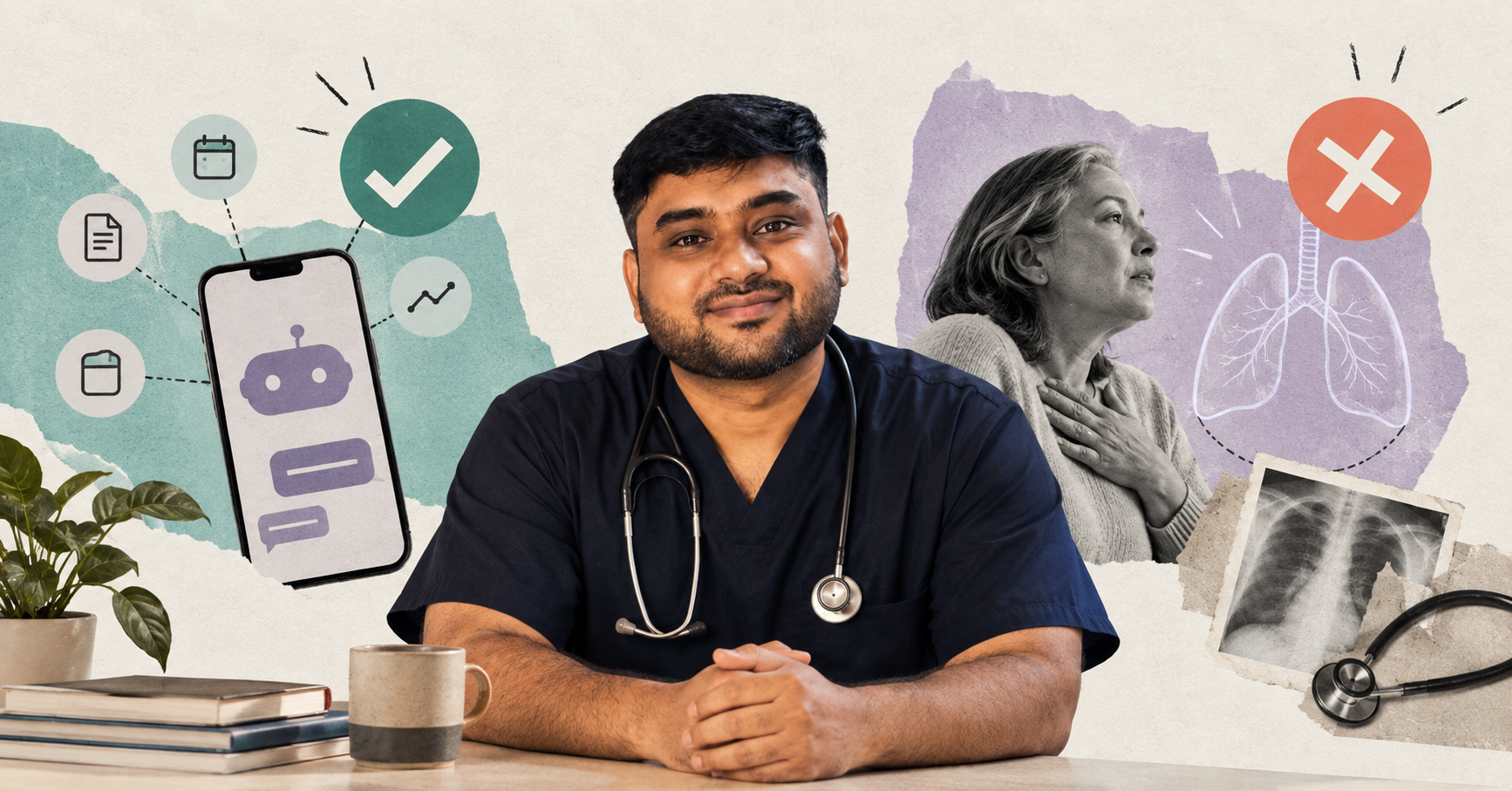
- The one thing an AI assistant helps with is turning a vague concern into an organized history and a rough sense of how quickly you need a doctor. It cannot examine you, and a breathing problem depends on information an AI assistant can't gather.
- Your oxygen level is the single most important thing it cannot see. You can sound completely normal in a chat window and still be dangerously low on oxygen. A basic fingertip pulse oximeter, typically ₹500–₹3,000 depending on brand and accuracy, tells you more about a respiratory emergency in ten seconds than any AI assistant.
- A persistent cough is not a low-stakes symptom in India. The WHO Global Tuberculosis Report 2025 puts India's 2024 caseload at roughly 2.7 million, about a quarter of the world's total, and the classic presentation of TB is exactly the cough that won't go away.
- AI triage has improved, but it isn't trustworthy unsupervised. A 2025 systematic review and meta-analysis in BMC Emergency Medicine found pooled emergency-triage accuracy of about 51% for GPT-3.5 and 70% for GPT-4-class models: better than a coin flip, but well short of a physician.
- What you type is personal health information, and India's protections for it are still being phased in. The Digital Personal Data Protection Rules' core obligations, including breach notification and enforceable data-principal rights, don't take full effect until May 2027, and the law has no separate, stricter category for health data the way the EU's GDPR does.
- Children should escalate fastest of anyone. Rapid breathing, a bluish tint, grunting, and the skin drawing in around the ribs are emergencies an AI assistant cannot monitor.
Type “cough for two weeks, should I be worried” into any AI assistant and you’ll get a composed, well-organized, often logical answer back. The problem is that a respiratory complaint is one of the few areas of medicine where the most important information is physical: your oxygen level, the sounds in your chest, how hard you’re working to breathe. None of that travels through a text box. An AI assistant can be a genuinely useful first step, and it can also miss the one detail that should have sent you to the hospital.
This guide walks through both sides: where an AI assistant actually helps with a breathing problem, and where it can mislead you without any obvious red flag. For the wider picture, see our guide to AI agents in family health.
What it’s actually good for, and the one rule
With a breathing complaint, an AI assistant does three things well. It turns a disorganized story (“I’ve had this on and off, worse at night, a bit of a wheeze”) into a tidy medical history. It offers a plausible list of possible causes. And it gives you a general sense of urgency. Used this way, it can get you to the right care faster, especially at two in the morning, or when you’re debating whether tomorrow will do.
Use an assistant to decide whether and when to see a doctor, never to conclude that you don’t need to. If a red-flag sign is present, contact a clinician or the emergency room rather than write a better-worded prompt.
What an assistant structurally cannot see
An AI assistant works only from what you type. A pulmonologist in the room is reading a set of signals the assistant never receives at all.
To be fair, a competent assistant will often ask about several of these, and that’s a real point in favor of the better tools. But asking about a symptom isn’t the same as observing it, and because low oxygen dulls a person’s own sense of alarm, people frequently underreport or misjudge their own breathing.
Three situations, and where the assistant helps versus misleads
Here’s the same breakdown at a glance, before the detail on each situation below.
| Situation | What AI reasonably flags | What it’s likely to miss | When to escalate |
|---|---|---|---|
| Persistent dry cough | Common, low-stakes causes: reflux, post-nasal drip, cough-variant asthma, a post-viral cough, or an ACE-inhibitor side effect | Tuberculosis, which India accounts for roughly a quarter of global cases of. It can’t order a chest X-ray or sputum test, or verify blood, night sweats, or weight loss | Blood in the sputum, weight loss, night sweats, a cough over two weeks, or a known TB contact at home |
| The wheeze | The asthma-vs-COPD distinction, common triggers, and rescue inhaler guidance | Severity. A fading wheeze can mean danger, not improvement, and it won’t ask about air pollution or smoke exposure unprompted | Inhaler relief lasting under four hours, SpO₂ under 94%, breathlessness at rest, or unable to finish a sentence |
| Sudden breathlessness | A general symptom summary and a plausible list of causes | Which fast-moving cause it is. Can’t rule out a pulmonary embolism, heart attack, or pneumothorax without an exam, ECG, and imaging | Any sudden, severe breathlessness, especially with chest pain, a swollen calf, blue lips, fainting, or SpO₂ under 92%: go now |
1. The persistent dry cough
What AI reasonably flags: the usual, low-stakes explanations: acid reflux, post-nasal drip, cough-variant asthma, a post-viral cough that outlasts the virus, or the dry cough some blood-pressure medications (ACE inhibitors) cause. It will typically, and correctly, tell you that a cough lasting more than two to three weeks needs to be checked.
What it’s likely to under-weight in India: tuberculosis. The classic presentation of TB is a cough lasting more than two weeks, and India accounts for roughly a quarter of the world’s TB cases and around a third of its drug-resistant cases, according to the WHO Global Tuberculosis Report 2025. An assistant trained mostly on Western data can default to reflux or allergies and quietly rank TB far down the list. It also can’t order the one test that actually answers the question: a chest X-ray or sputum test. And it can’t verify the details that change everything: blood in the sputum, drenching night sweats, unexplained weight loss, or a fever pattern.
When to stop typing and see a doctor:any blood in the sputum, weight loss, night sweats, a cough lasting more than two weeks, or a known TB contact at home. TB testing is free in India’s public health system, which is worth a clinic visit, not another prompt.
2. The wheeze
What AI reasonably flags: the general distinction between asthma and COPD, common triggers, and the idea that a rescue inhaler plus a proper evaluation is the sensible path.
What it’s likely to miss:severity. How loud a wheeze is doesn’t track how dangerous it is, and even good tools get this wrong. A wheeze that fades in a struggling patient can mean too little air is moving to make a sound anymore. An AI assistant reading “my wheeze has settled down” may log that as reassurance, where a clinician would flag it as a warning.
Wheezing in India also isn’t only asthma. Just over half of the country’s COPD burden, 53.7% of disability-adjusted life years, is attributable to air pollution, according to a Global Burden of Disease analysis published in The Lancet Global Health. An AI assistant won’t ask about exposure to city air, biomass cooking smoke, or workplace dust unless you specifically bring it up.
When to see a doctor, or go now: a rescue inhaler that stops working within four hours, an oximeter reading under roughly 94%, wheezing with breathlessness at rest, or being unable to finish a sentence.
3. Sudden breathlessness
This is the situation where an AI assistant is most likely to be actively dangerous: the safest move is almost never “let me describe this to an AI assistant first.” The worst causes of sudden breathlessness move fast, and several can be fatal within hours:
- A pulmonary embolism (a clot in the lung)
- A heart attack or heart failure presenting as breathlessness instead of chest pain
- A pneumothorax (a partially collapsed lung)
- A severe asthma attack or anaphylaxis
- Rapidly progressing pneumonia
What AI can’t do is tell these apart without an exam, an ECG, and imaging, and it can’t watch you decline while you type. A confident, well-written “this sounds like anxiety” is a real failure mode here, not a hypothetical one. A 2025 systematic review and meta-analysis in BMC Emergency Medicine found large language models remain inconsistent and prone to overconfident errors in emergency-triage tasks, with pooled accuracy of about 51% for GPT-3.5 and 70% for GPT-4-class models, well short of physician-level performance.
Sudden, severe, or new breathlessness is an emergency, especially alongside chest pain, a swollen or tender calf, blue lips, fainting, or an SpO₂ under 92%. Call for help or go straight to the nearest emergency room. There is no useful step to take with an AI assistant first.
The privacy footnote Indian readers shouldn’t ignore
India’s data-protection rules for health information are still being phased in, and in the meantime, whatever you type into a general-purpose assistant is personal health data about you. The Digital Personal Data Protection Act, 2023 has no separate, stricter category for sensitive health data the way the EU’s GDPR does. Its implementing rules were notified on November 13, 2025. But the obligations that would actually protect a health conversation, mandatory breach notification, notice requirements, and enforceable data-principal rights, don’t take full effect until May 13, 2027. In the interim, a general-purpose AI assistant can sit largely outside dedicated healthcare privacy protection.
In practice, describing symptoms in general terms is fine. Pasting an entire report into a consumer AI assistant with your name, phone number, or ABHA health-ID attached is a decision worth making deliberately, not a default. Our breakdown of what the current evidence actually shows about sharing family health data with AI covers the wider version of this question in more depth.
The checklist for escalation
Warning signs that mean you stop using AI assistants and see a doctor:
Where an AI assistant truly works
For respiratory issues, an AI assistant works best alongside doctor visits, not instead of them: helping you stick to an inhaler or TB treatment plan, organizing your history before an appointment, and tracking how a report changes over time. That last job is a records-and-continuity task, and it’s better handled by a dedicated health-records platform built to protect that data than by a general AI assistant you’ve pasted your medical life into.
Kai, Kaizen's AI assistant, helps your family organize and track medical records and reports over time on a HIPAA-compliant platform where your health data is never used to train the underlying model, kept separate from a general-purpose chat window.
Try it with a documentIf your, or a parent’s, medical history isn’t organized yet, our guide to organizing medical records for aging parents is worth doing first, and our AI agent vs. chatbot breakdown covers what changes once a tool can act on that history instead of just responding to it.
Frequently Asked Questions
No. It can help you judge whether your cough sounds like something that needs same-day attention, but a cough is diagnosed through examination and, if needed, a sputum test or chest X-ray, neither of which an AI assistant can order or perform. In India specifically, a doctor needs to rule out tuberculosis if a cough lasts more than two weeks.
Be cautious. Beyond the accuracy limits, a scan report usually carries your name and other identifiers, and under India's data protection rules, which are still being phased in, a general consumer AI assistant may offer little to no dedicated protection for that information. If you want a second opinion, see a doctor. If you just need help understanding a report you already have, describe it in general terms rather than uploading the full identified document.
No. Children should escalate the fastest of anyone. Rapid breathing, a bluish tint, grunting, and the skin drawing in around the ribs are emergencies, and an AI assistant cannot monitor a child in real time. Children can also decline far more quickly than adults.
Treat it as one input, not a conclusion. Even frontier models fall well short of a doctor on triage accuracy: a 2025 systematic review and meta-analysis in BMC Emergency Medicine found pooled accuracy of about 70% for GPT-4-class models on emergency-triage tasks, and "probably viral" is a comforting answer that can just as easily mask heart failure, early asthma, or tuberculosis. The assistant's reassurance shouldn't outrank a warning sign like a cough lasting more than two weeks.
A fingertip pulse oximeter. It's inexpensive and gives you an objective number for a respiratory problem that no AI assistant can provide. Take a reading under 94% seriously, and get medical attention right away if it falls below 92%.